Welcome to AccelNet Toxo
Toxoplasma gondii is a global parasite that impacts people and a wide array of animals. Capable of accumulating in invertebrates like mussels and snails, persisting in the environment, and being carried by water, this parasite is found in many different terrestrial and aquatic environments. However, field methods and diagnostic approaches vary widely across international research groups and geographic regions, limiting understanding of global patterns of parasite transmission and evolution.
Using a One Health approach, we are building a collaborative global community of researchers and practitioners from diverse disciplines, backgrounds, and perspectives to collectively develop shared research, training, and outreach approaches to understand parasite transmission and reduce impacts on human and animal health.
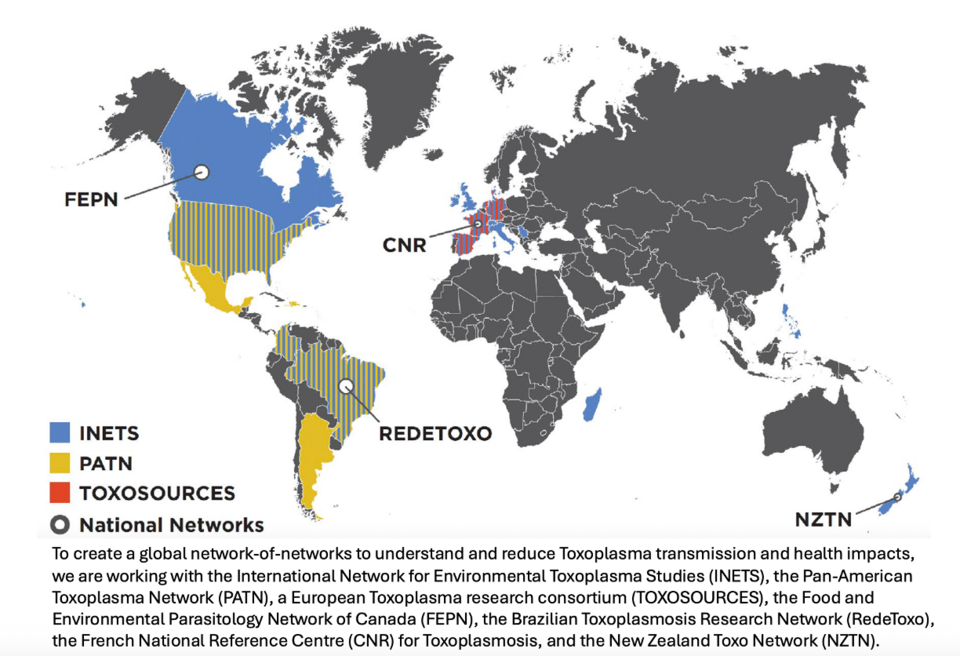
We are connecting existing and emerging Toxoplasma research networks, including global and Pan-American networks as well as national networks from France, Canada, Brazil, and New Zealand, to identify shared research goals and methods, create new opportunities for student training, and integrate data from parasite research in different regions.
As Toxoplasma infection adversely impacts human and animal populations globally, this project will enhance public and animal health and well-being as well as wildlife conservation by providing critical information on parasite transmission and identifying opportunities for disease prevention in people and sensitive animal populations. Our workforce development and global networking efforts will also include developing collaborative virtual and in-person outreach approaches and enhancing communication with groups ranging from healthcare and animal management professionals to the broader public.
Join Us for Our Upcoming Workshop
June 11 – 14, 2026
Buzios, Brazil
Current Networks Involved
INETS
INETS was established in 2019 to formally connect and share information among an international group of students, postdocs, and established researchers with the goal of enhancing research on the environmental transmission of T. gondii. The INETS mission is to integrate efforts and connect scientists who are invested in advancing knowledge on T. gondii oocysts and transmission dynamics that shape the epidemiology of toxoplasmosis. The growing INETS network maintains a public website, hosts quarterly webinars, and provides online resources to enhance research and outreach on the environmental transmission of T. gondii. INETS currently includes over 90 members from universities, government agencies, and private organizations in North and South America, Europe, Africa, Asia, and New Zealand. Members of this network represent diverse fields including veterinarians, public health professionals, parasitologists, ecologists, pathologists, epidemiologists and environmental engineers.
Learn More
Pan-American Toxoplasma Network (PATN)
Motivated by the need for collaboration across the Americas to enhance research on T. gondii and toxoplasmosis, PATN is an emerging network (inspired by the successful history of the Brazilian Toxoplasmosis Research Network), proposed during a discussion organized by RedeToxo at the 2023 VI Brazilian Symposium on Toxoplasmosis & III International Symposium on Toxoplasmosis. The event brought together researchers from Argentina, Brazil, Colombia, the Dominican Republic, Mexico, and the United States. PATN aims to leverage collective expertise in health education, epidemiology, diagnostics, and treatment, focusing on enhancing early detection and improving neonatal screening. Committed to advancing public health across the Americas, the network addresses the shared challenges of T. gondii infection and the critical gaps in understanding strain diversity. Although still in its early stages of development, members from Argentina, Brazil, Colombia, the Dominican Republic, Mexico, and the United States, are actively engaging with peers in their respective countries to collaborate on a unified agenda.
Learn More
European Toxoplasma Research Consortium (TOXOSOURCES)
The TOXOSOURCES project funded through the European Union’s Horizon 2020 Programme under One Health European Joint Programme began in 2020 and provided a unique international collaboration with optimal complementary expertise on T. gondii at the interface of humans, animals, food, and environment. The TOXOSOURCES project focused on the relative contributions of the different sources of T. gondii infection using multidisciplinary approaches and novel and improved methods to yield the most robust estimates possible to inform risk management and policy makers. Research groups and laboratories across the consortium have addressed topics relevant to parasite ecology and transmission at the human-animalenvironment interface. The results are integrated to contribute to developing efficient interventions at national, regional, European and global levels. Research groups from more than 20 organizations are involved in the TOXOSOURCES consortium, including groups from the Statens Serum Institut (Denmark), the National Institute for Public Health and the Environment (RIVM; the Netherlands), the Friedrich-Loeffler-Institut (Germany), and the Complutense University of Madrid (Spain).
Learn More
Food and Environmental Parasitology Network of Canada (FEPN)
In 2009, the Bureau of Microbial Hazards at Health Canada established a network of Canadian researchers, regulators, and public health officials with an active involvement in issues related to food and environmental parasitology. The scope of the FEPN includes foodborne, waterborne, and zoonotic parasites of public health concern in Canada. FEPN is the first formal network addressing these issues in Canada and brings together experts in this important and emerging field. FEPN currently has over 70 members from across Canada representing federal and provincial government, academia, and industry. The objectives of the FEPN are to identify and communicate risks and research gaps relevant to food and environmental parasitology, to facilitate discussion and collaborative research amongst members, and to provide expert advice to government agencies and the public. The FEPN is a member society of the World Federation of Parasitologists.
Learn More
Brazilian Toxoplasmosis Research Network (RedeToxo)
The Brazilian Toxoplasmosis Research Network is a non-governmental organization formally established in 2016. It operates as a non-profit association with scientific, social, and educational objectives. Its purpose is to promote research collaboration and share clinical care experiences to find comprehensive solutions for toxoplasmosis, broadly benefiting the Brazilian population. The network serves as a continuous dialogue platform among national researchers, international partners, and professionals in human, animal, and environmental health, while also advocating for the implementation of public policies for toxoplasmosis control. Currently, it comprises approximately 70 associated researchers, partnering with public universities and research centers in Brazil as well as government bodies at municipal, state, and federal levels. Over the past seven years, the network's collaboration with the Ministry of Health has been crucial for advancing public policies related to toxoplasmosis. During this period, congenital toxoplasmosis became a notifiable disease, and Brazil approved a law within its Unified Health System that includes toxoplasmosis in universal neonatal screening. Brazil faces unique challenges in mitigating congenital toxoplasmosis, making it essential to implement and maintain neonatal screening until risks to vulnerable populations are significantly reduced.
Learn More
French National Reference Centre (CNR) for Toxoplasmosis
The CNR is a national network that was established in 2006 with the main objectives to improve epidemiological knowledge of toxoplasmosis in France and to assess diagnostic practices with a view to achieving greater standardization in patient care. The network engages 69 researchers in 22 laboratories distributed throughout the country. To meet these objectives, the CNR is supported by a network of specialized public hospital laboratories that are deeply involved in the diagnosis, epidemiology, and treatment of toxoplasmosis and are recognized for their excellence in the field of toxoplasmosis.
Learn More
New Zealand Toxo Network (NZTN)
The New Zealand Toxo Network is a developing consortium involving researchers, industry members and stakeholders with an interest in better understanding and mitigating the impact of toxoplasmosis in New Zealand. The network has a broad, holistic reach, incorporating input from the veterinary, human health, agriculture, epidemiology, aquaculture, disease control, indigenous knowledge and wildlife management disciplines. Network members are working to build connections and foster information-sharing through new (e.g. specific research or management initiatives) and existing (e.g. One Health Aotearoa) national platforms and provide an avenue for connecting with similar international bodies. The network was established as a national T. gondii research advisory group in late 2022, with 25 formal members representing research, industry and national and local government. In the past two years, network representatives have been actively leveraging networking and relationships of foundation members to grow network engagement.
Learn More